English Medium ChemistryNBF · 2026-2027
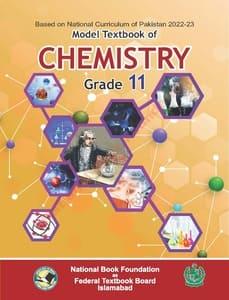
Federal Board Grade 11 Chemistry English-medium textbook cover for the 2026-2027 session

11th Class Chemistry Book PDF for FBISE 2026-2027

The 11th Class Chemistry Book PDF is an English-medium textbook for HSSC Part 1 students studying under the Federal Board of Intermediate and Secondary Education (FBISE). Published by the National Book Foundation (NBF), this 2026-2027 edition follows the National Curriculum of Pakistan. FBISE students, teachers, and self-study learners can read the textbook online or download the PDF for free through StudyPlusPlus. Chapter-wise English Chemistry notes are also available on our platform to support revision, conceptual understanding, and Federal Board annual exam preparation.

🌿 Subject: Chemistry Grade 11· English·🎓 Class: HSSC Part 1 / 1st Year·🏫 Board: Federal Board of Intermediate and Secondary Education (FBISE)·📅 Session: 2026-2027·🏛 Publisher: National Book Foundation (NBF)·📄 Format: PDF
Advertisement
🧪
Class 11 Chemistry — Federal Board (NBF)
Session 2026-2027  ·  HSSC Part 1  ·  Free PDF
View Notes
⬇ Download PDF

Overview

11th Class Chemistry Book PDF for Federal Board

The 11th Class Chemistry Book PDF for FBISE is the primary English-medium Chemistry textbook for students in higher secondary education under the Federal Board of Intermediate and Secondary Education. Prepared by the National Book Foundation (NBF), this textbook aligns with the 2026-2027 academic session and follows the national educational framework.
Students can use this platform to read the Chemistry textbook online or access the PDF download for offline study. The textbook is designed to facilitate conceptual clarity, practical understanding of chemical principles, and systematic examination preparation.

About the Class 11 Chemistry Book

The Class 11 Chemistry book provides a comprehensive introduction to foundational and advanced concepts in physical, inorganic, and organic chemistry. Aligned with the latest National Curriculum of Pakistan, it consists of 22 chapters covering topics starting from history of chemistry, atomic models, quantum numbers, and chemical bonding, to stoichiometry calculations, thermodynamics, kinetics, and equilibrium.
The final chapters focus heavily on organic chemistry, introducing catenation, aliphatic compound nomenclature, and detailed reaction mechanisms of hydrocarbons, halogenoalkanes, alcohols, carbonyl compounds, and amines. It also covers modern concepts in organic synthesis, retrosynthesis, and energy fuel technologies, making it an excellent bridge for students moving toward engineering, medical, and chemistry-related fields at the university level.

Why Chemistry Is Important for Class 11 Students

Chemistry is a fundamental science subject for students pursuing careers in pre-engineering, pre-medical, pharmacy, biotechnology, and chemical engineering. Concepts learned in Grade 11, such as molecular orbital theory, enthalpy changes, Born-Haber cycle, chemical equilibrium constants, pH calculations, and organic reaction mechanisms, are directly tested in intermediate board examinations and university entrance tests like ECAT and MDCAT.
By studying this textbook, students develop analytical thinking and problem-solving skills, learn to perform chemical calculations (like limiting reactant and yield determinations), interpret scientific graphs, and understand the chemical reactions and molecular structures that form the basis of the physical world.

Curriculum and NBF Information

This FBISE textbook is published by the National Book Foundation (NBF) under the National Curriculum of Pakistan. The curriculum is designed with an outcome-based learning approach, prioritizing deep conceptual understanding over simple rote memorization.
Students looking for the latest Federal Board book or NBF Chemistry PDF can trust this resource as it represents the officially prescribed syllabus for the 2026-2027 session. The book incorporates modern educational standards, making it highly compatible with global high school level science curricula.

Federal Board Exam Preparation

To prepare effectively for the FBISE Class 11 Chemistry exam, students should focus on both theoretical concepts and numerical applications. Key areas of focus include stoichiometry calculations, quantum number assignments, VSEPR shapes of molecules, Hess's Law, buffer solutions pH, and organic synthesis pathways.
Practising the conceptual assessment questions, balancing equations, and solving numerical problems at the end of each chapter will ensure solid preparation. Additionally, utilizing the official solved Class 11 Chemistry notes alongside the textbook helps students clarify complex doubts and master the exam-writing format.

Features of This Chemistry Textbook

  • Updated curriculum coverage: Aligned with the latest National Curriculum of Pakistan for the 2026-2027 session.
  • Federal Board alignment: Matches the official FBISE assessment patterns and course outlines.
  • Student-friendly explanations: Complex reaction mechanisms and quantum concepts are simplified with step-by-step guidance.
  • Conceptual learning: Focuses on analytical questions and real-world applications of chemistry.
  • Diagrams and chemical equations: Includes high-quality visual aids, molecular orbital diagrams, and schematic representations to explain chemical structures.
  • Exercises and practice material: Each chapter is packed with multiple-choice questions, conceptual queries, and numerical problems.
  • Exam-preparation support: Solved examples within chapters provide a template for board exam response writing.
  • Online and offline access: Read online or download the complete PDF for offline preparation.

Who Should Use This Chemistry Book?

  • Federal Board Class 11 Students: FBISE students can use this textbook as their primary Chemistry learning resource for the 2026-2027 academic session. It supports classroom study, homework, revision, and annual examination preparation.
  • Chemistry Teachers: Educators can use the textbook's structured chapter sequence, practice problems, conceptual questions, and exercises to plan lectures, assignments, practical activities, and mock tests.
  • Tuition Academies: Tuition centres and academies preparing intermediate students for Federal Board examinations can use this model textbook to align their course outlines and weekly test plans.
  • Self-Study Students: Students studying independently can follow the chapters in order, make conceptual notes, practice stoichiometry exercises, and verify their understanding using online resources.
  • Students Preparing for Examinations: Learners revising for board exams, improvement exams, or competitive entrance preparation (like MDCAT/ECAT) can use the textbook to review core chemical reactions, mechanisms, and formulas.

Chapters Included in 11th Class Chemistry Book FBISE

The FBISE Grade 11 Chemistry textbook contains 22 chapters covering physical, inorganic, organic and environmental chemistry.

1History of Chemistry
2Atomic Structure
3Chemical Bonding
4Stoichiometry
5States and Phases of Matter
6Energetics
7Chemical Kinetics
8Chemical Equilibrium
9Acids - Bases Chemistry
10Periodic Table
11Nitrogen and Sulphur
12Halogens
13Environmental Chemistry-Air
14Environmental Chemistry-Water
15Organic Chemistry
16Hydrocarbons
17Halogenoalkanes
18Alcohol
19Carbonyl Compounds
20Nitrogen Compounds-Amines
21Organic Synthesis
22Energy

* Chapter numbers follow the standard Federal Board Class 11 Chemistry curriculum for Intermediate Part 1 students.

How to Use This Book

Accessing the Federal Board Class 11 Chemistry book on this page is quick and simple:

  1. View OnlineUse the embedded PDF viewer above to read any chapter directly in your browser. No download is needed.
  2. Download PDFClick the Download PDF button in the bar above the viewer to save the complete book on your device for offline study.
  3. Share FreelyShare this page with classmates, students, or teachers who need the book. It is always free and accessible.

This resource is provided for free educational use only. It is not intended for commercial reproduction, resale, or redistribution.

Download Book PDF

Download Class 11 Chemistry Book in PDF format for offline study, revision and exam preparation.

Disclaimer: This textbook is shared by StudyPlusPlus for educational and non-commercial purposes only. The publication and curriculum rights remain with their respective authorities, including the National Book Foundation and relevant education bodies. Students should use the resource for learning, classroom support and personal exam preparation.
Advertisement

Frequently Asked Questions

You can access the Class 11 Chemistry Book PDF through StudyPlusPlus
Yes, this book page is prepared for the 2026-2027 academic session. It aligns with the National Curriculum of Pakistan and is published by the National Book Foundation (NBF) as the model textbook.
The Grade 11 Chemistry textbook is published by the National Book Foundation (NBF), which acts as the Federal Textbook Board for Islamabad.
Absolutely. This textbook is specifically designed for intermediate Grade 11 students under the Federal Board (FBISE) to cover their core chemistry syllabus and prepare for annual examinations.
Yes, it is aligned with the National Curriculum of Pakistan. It serves as the model textbook approved for Federal Board students starting from the 2026-2027 academic session.
The textbook contains 22 chapters, starting from History of Chemistry, Atomic Structure, and ending with modern concepts in Organic Synthesis and Energy.
Yes. English-medium Class 11 Chemistry notes are available on 11 Chemistry Notes | StudyPlusPlus. Students can use the chapter-wise solved notes, conceptual questions, and exam-preparation guides to support their learning.
Yes, because it provides clear conceptual explanations, solved examples, and detailed molecular diagrams. Practising the conceptual questions and stoichiometry problems helps students build a strong foundation for competitive entrance exams like MDCAT and ECAT.
The book covers fundamental atomic models, chemical bonding, stoichiometry, gas and liquid states of matter, thermochemistry, kinetics, equilibrium, acid-base systems, periodic table periodicity, halogen chemistry, organic structures, reaction mechanisms, functional groups, retrosynthesis, and energy fuel concepts.