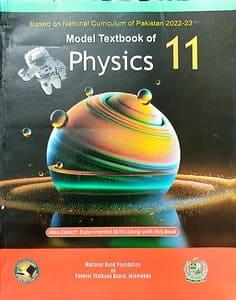
Access chapter-wise SLO-based solved exercises, numerical problems, conceptual MCQs, short questions, and long questions based on the latest National Book Foundation (NBF) textbook.
Federal BoardClass 11HSSC-IPhysicsEnglish MediumSession 2026-2027SLO BasedSNC AlignedNBF TextbookChapter-Wise Notes
Quick Answer
Looking for the latest Class 11 Physics solved notes for Federal Board (FBISE)? StudyPlusPlus offers complete, step-by-step solved exercises, conceptual short questions, numerical solutions, derivations, and SLO-based practice questions based on the 2026-2027 NBF textbook. These resources are designed to help HSSC-I pre-engineering, pre-medical, and ICS students build conceptual clarity and score top marks in their annual board examinations.
Chapter-Wise Physics Notes
Select any chapter to read online or download the PDF notes for exam preparation.
Chapter 1
Physical Quantities and Measurements
Understand estimation of physical quantities, derived units in terms of base units, dimensions (advantages and limitations), precision, accuracy, and rules for calculating uncertainties in final results.
Learn about vector resolution including rectangular components, finding vectors from components, and products of vectors (scalar/dot product and vector/cross product).
Master equations of uniformly accelerated motion, free-fall, projectile motion (horizontal and angular launch with air resistance), conservation of momentum, and elastic/inelastic collisions.
Study work done by constant and variable forces (force-displacement graph), conservative and non-conservative fields, and the work-energy theorem with efficiency.
Explore thermal equilibrium, internal energy, gas laws, kinetic theory, first law (isothermal, adiabatic), heat engines, second law, Carnot engine, refrigerator, and entropy.
Master drift velocity, electric potential, EMF, variation of resistance with temperature, LDRs, Kirchhoff's laws, wheatstone bridge, potentiometer, and thermistors.
Study magnetic fields due to current, force on conductors, motion of charge, velocity selector, field patterns, solenoids, magnetic flux, Faraday's and Lenz's laws.
Learn inertial/non-inertial frames of reference, special theory of relativity, its consequences (length contraction, time dilation, mass variation), and spacetime.
Class 11 Physics is a fundamental subject for HSSC-I students, particularly those in pre-engineering, pre-medical, and ICS groups. The syllabus contains highly conceptual and analytical topics such as vectors, rotational dynamics, work-energy relationships, fluid dynamics, and thermodynamics. Rote learning is insufficient for this subject; students must develop strong logical reasoning, conceptual clarity, and step-by-step problem-solving abilities.
These FBISE Class 11 Physics notes have been designed to align with the Student Learning Outcomes (SLO) model. Rather than just providing final answers, these notes break down each step of the solutions, show the physical rules applied, and explain key mathematical derivations and numerical calculations. This makes it easier for students to understand the underlying physical laws.
By studying these notes, students will find solved exercises from the latest NBF textbook, conceptual short questions that test theoretical understanding, detailed solutions to numerical problems, and comprehensive explanations of physical principles. This structured approach helps in building a solid foundation for both board exams and competitive engineering and medical college entrance tests (ECAT & MDCAT).
What Are These Physics Notes?
These Class 11 Physics notes serve as a complete digital companion for self-study and classroom support. They act as a reliable guide for students who want to verify their answers, understand complicated derivations, or catch up on missed lectures.
The notes are structured to match the student's learning journey, starting with simple definitions, moving to solved textbook exercises, and concluding with exam-prep practice problems.
Here is a summary of the core materials included in these notes:
Chapter summaries and quick-revision formula sheets
Important physical quantities, constants, and dimensions
Step-by-step solved textbook exercises
Numerical problems solved with clear steps and units
Conceptual solved MCQs to test quick thinking
Short questions covering proofs and logical deductions
Detailed long-answer derivations and complex theorem proofs
Physical diagrams and circuit analyses
SLO-based practice questions designed for FBISE exams
Time-saving tips for physical calculations
Use these study materials to review key topics and improve your physical accuracy.
What Is Included in the Notes?
Students can use the chapter-wise material to access the following learning resources:
✓
Solved Exercises
Complete, step-by-step solutions for every exercise in the Class 11 Physics NBF textbook, showing all mathematical steps.
A
MCQs
Multiple-choice questions with detailed reasoning to help students master conceptual objective sections of the board exam.
Q
Short Questions
Conceptual short-answer questions that test physical definitions, simple proofs, and core properties of operations.
L
Long Questions
Comprehensive long questions, including complex algebraic derivations, word problems, and physics proofs.
D
Definitions
Clear and precise physics definitions, including terms like vectors, moment of inertia, terminal velocity, and entropy.
◎
Diagrams
Physical diagrams, Cartesian graphs, vector plots, and circuit diagrams to aid visual learning and conceptual clarity.
★
SLO-based Questions
Exam-style application and analysis questions that match the latest Federal Board (FBISE) examination patterns.
↓
PDF Download
Free offline access. Download chapters in high-quality PDF format for continuous, uninterrupted learning.
SNC and National Curriculum Alignment
These Class 11 Physics notes are fully aligned with the Single National Curriculum (SNC) and the Student Learning Outcomes (SLO) framework adopted by the Federal Board of Intermediate and Secondary Education (FBISE). The content is mapped directly to the National Book Foundation (NBF) textbook for the 2026-2027 academic session, ensuring students study the correct exam-relevant syllabus.
How to Prepare Class 11 Physics from These Notes
Follow this simple preparation method to get better results in Physics.
1
Read the textbook chapter first
Start by studying the textbook definitions, physical laws, and solved examples to understand the core theories before jumping into the exercise questions.
2
Revise key concepts
Review the summary sections and formula sheets in these notes to solidify your understanding of physical laws and constants.
3
Solve MCQs
Attempt the conceptual MCQs in these notes to test your quick-calculation skills and conceptual recall for the objective paper.
4
Prepare short questions
Solve short-answer questions, focusing on applying properties, finding specific values, and proving simple physical relations.
5
Prepare long questions
Work through the long questions, ensuring you understand every intermediate step and algebraic manipulation needed for detailed derivations.
6
Practice diagrams
Practice drawing neat diagrams, vector representations, and circuit schematics, as visual geometry is key in board marking.
7
Revise before tests and board exams
Use the compiled list of key formulas and equations in these notes for quick revision cycles before tests, helping keep physical laws fresh in your mind.
Related Resources
Use these resources to complete your Physics preparation and other subjects.
Are these Class 11 Physics notes based on the latest NBF syllabus?
Yes, these notes are fully updated for the 2026-2027 session and are aligned with the National Book Foundation (NBF) textbook for Class 11 Physics (HSSC-I).
What does SLO-based notes mean for Federal Board Physics students?
Student Learning Outcomes (SLO) based notes focus on deep conceptual understanding, analytical thinking, and logical applications of physical laws, helping students solve unfamiliar conceptual questions in FBISE board exams.
Can I download the Class 11 Physics solved exercises PDF?
Yes, you can download the PDF files for solved exercises, numericals, formulas, and notes for each chapter individually from their respective pages.
Do these notes cover all the chapters of HSSC-I Physics?
Yes, they cover all 14 chapters of Class 11 Physics, from Physical Quantities and Measurements to Particle Physics, including textbook exercises, review exercises, and extra practice questions.
Is the content aligned with the Single National Curriculum (SNC)?
Yes, the syllabus is aligned with the Single National Curriculum (SNC) guidelines adopted by the Federal Board of Intermediate and Secondary Education.
How can these notes help me prepare for the MDCAT or ECAT?
Physics is a key subject with high weightage in entry tests like ECAT and MDCAT. These notes cover core concepts, fundamental derivations, and conceptual reasoning which are highly beneficial for entry test preparation.
Are the long questions in these notes structured for board exam marking schemes?
Yes. Every long question and physical derivation is written with logical step-by-step mathematical steps, justifications, and clear diagrams to help you secure full marks in the subjective section of the board paper.
Can students from the Punjab Board use these FBISE Physics notes?
Yes, since the National Curriculum is largely synchronized across Pakistan, Punjab Board students can use these notes to study overlapping chapters like Vectors, Motion, and Thermodynamics, though they should verify their specific textbook exercises.
Are there solved MCQs included in these notes?
Yes, each chapter notes page includes solved multiple-choice questions, covering both textbook exercises and extra conceptual board questions to prepare you for the objective section.
Do these notes contain formula sheets and key derivations?
Yes, key formulas, physical constants, and important derivations are highlighted in each chapter to facilitate quick revision before tests and board exams.
What is the best way to prepare for Class 11 Physics annual exams?
Read the textbook first to understand the concepts, review the solved examples, solve the textbook exercises and numericals step-by-step using these notes, practice drawing diagrams, and attempt past papers under exam conditions.
Are these solved notes free to access online?
Yes, all solved notes, exercises, MCQs, and downloads on StudyPlusPlus are 100% free for educational use by students and teachers.
How does the HSSC-I grading system affect Physics students?
Physics is a major subject with significant weightage in HSSC-I pre-engineering, pre-medical, and ICS. Securing high marks in both the subjective and objective parts is crucial for a strong overall HSSC score.
Are these notes suitable for weak students who struggle with physics?
Yes, these notes break down complex physical concepts, derivations, and mathematical steps into simple, detailed steps, making it easy to learn for students of all learning levels.
How do I download the notes for a specific chapter?
Simply select the chapter from the table of contents list above to navigate to that chapter's page, where you will find the direct PDF download button.
Educational Notice: This content is provided for educational support only. It is not for sale, redistribution, or commercial use. StudyPlusPlus is not claiming official ownership of any government textbook material.