Chapter 1
ExerciseSLO NotesHistory of Chemistry
Explore scientific methods, scientific paradigms, atomic models, the Phlogiston theory, and statistical uncertainty in chemistry.
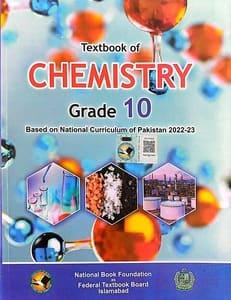
Prepare Class 10 Chemistry SSC-II exams with SLO-based solved textbook exercises, conceptual MCQs, important questions, and revision guides.
This page provides free solved study notes, multiple-choice questions (MCQs), short-answer questions, and detailed long-answer questions for 10th Class Chemistry under the Federal Board (FBISE) curriculum. All materials align with the latest National Book Foundation (NBF) textbook for the 2026-2027 academic session, focusing on Student Learning Outcomes (SLO) such as Stoichiometry, Electrochemistry, and Organic Chemistry.
Select any chapter to read online or download the PDF notes for exam preparation.
Explore scientific methods, scientific paradigms, atomic models, the Phlogiston theory, and statistical uncertainty in chemistry.
Study heating and cooling curves, changes of state, evaporation under varied pressure, gas laws, and the diffusion of gases.
Understand the mole concept, empirical and molecular formulas, limiting reactants, percent yield, and concentration units like molarity.
Examine electrolysis, electrolytic and Galvanic cells (Daniel Cell), electroplating, the electrochemical series, and fuel cells.
Analyze chemical reaction rates, collision theory, activation energy, catalytic enzymes, and kinetics in the food industry.
Investigate physical properties of ionic compounds, methods for preparation of soluble/insoluble salts, and salt purification.
Learn about photochemical smog, acid rain, industrial processes like Haber and Contact processes, metal reactivity, and oxides.
Understand structural formulas, IUPAC naming rules for alkanes, alkenes, alkynes, alcohols, carboxylic acids, and ester structure.
Study saturated vs unsaturated hydrocarbons, preparation and properties of alkenes/alkynes, fossil fuels, and crude oil refining.
Explore the industrial manufacture of ethanol, combustion of alcohols as fuels, and roles of alcohols in cosmetics and pharmaceuticals.
Understand ethanoic acid preparation, reactions of carboxyl and hydroxyl groups, and applications of carboxylic acids and esters.
Analyze addition and condensation polymers, properties and environmental disposal challenges of plastics, and textile polymers.
Study proteins, carbohydrates, lipids, nucleic acids, health functions of vitamins, genetics engineering, and cloning techniques.
The 10th Class Chemistry Notes FBISE 2026-2027 serve as an essential study companion for students preparing for their Secondary School Certificate (SSC-II) exams. Chemistry in Class 10 transitions from basic atomic concepts to complex chemical interactions, industrial processes, and organic molecules. These notes are designed to break down challenging scientific topics—ranging from stoichiometry and electrochemistry to polymers, carboxylic compounds, and genetics—into easy-to-understand structured blocks.
Following the latest Student Learning Outcomes (SLO) guidelines introduced by the Federal Board, the matric exam system tests conceptual clarity and analytical thinking rather than rote learning. These notes align strictly with these SLO standards. They include multiple-choice questions (MCQs) that target conceptual understanding, and short questions that emphasize chemical reactions, calculations, and properties, making exam preparation straightforward and highly effective.
Furthermore, chemical equations and organic structures carry significant weight in the FBISE Chemistry exams. Our notes provide clean, step-by-step reaction pathways, formulas, and diagrams to help students secure maximum marks. Students can easily read the notes online or download chapter-wise PDFs for offline studying, facilitating seamless revision.
These Class 10 Chemistry notes are designed to simplify the extensive NBF textbook syllabus for FBISE English medium students. They provide clear explanations, logical definitions, and precise question-answer sets that mirror the requirements of Federal Board examiners.
Each chapter is organized to support the official National Book Foundation (NBF) textbook. Whether you are revising the steps of the Haber process, balancing stoichiometry equations, or studying the classification of proteins, these notes offer structured paragraphs and bullet points that make self-study simple and productive.
Using these notes helps students build confidence and structure their revision process. The notes cover the following essential components:
Students can use the chapter-wise material to access the following learning resources:
Complete and accurate answers to all NBF textbook exercise questions for every chapter.
SLO-aligned conceptual and memory-based multiple-choice questions with verified answer keys.
Concise answers to short questions focused on definitions, reactions, and quick comparisons.
Detailed and structured answers for long questions, featuring appropriate headings and reaction mechanisms.
Precise definitions of key chemical terms and scientific concepts from the curriculum.
Neat, labeled chemical apparatus setups and molecular structure diagrams.
Conceptual practice questions tailored to the latest FBISE analytical exam pattern.
Free downloadable PDF files for each of the 13 chapters, perfect for offline reading.
These Class 10 Chemistry notes are 100% aligned with the Single National Curriculum (SNC) and National Curriculum guidelines of Pakistan. They are structured according to the latest Student Learning Outcomes (SLO) framework prescribed by the Federal Board (FBISE) for the 2026-2027 academic session, utilizing the official National Book Foundation (NBF) textbook.
Follow this simple preparation method to get better results in Chemistry.
Begin by studying the textbook chapters published by NBF to gain a broad understanding of the chemical concepts and terminologies.
Go through the definitions and summaries in these notes to reinforce what you learned from the textbook.
Practice the conceptual MCQs to build quick recall and evaluate your objective-section prep.
Learn the short-answer questions to understand how to state scientific facts and write chemical equations concisely in the exam.
Study the long questions under proper headings and practice organizing your answers logically with proper reaction mechanisms.
Draw and label key experimental setups and write balanced chemical equations to improve your presentation skills.
Use the chapter-wise PDF downloads for quick revisions during class tests, send-ups, and final exams.
Use these resources to complete your Chemistry preparation and other subjects.
Yes, these solved notes are fully updated for the 2026-2027 academic session based on the latest National Book Foundation (NBF) textbook for FBISE.
Yes, these notes follow the Student Learning Outcomes (SLO) framework introduced by the Federal Board, emphasizing conceptual understanding rather than rote memorization.
Absolutely. All 13 chapters, from the History of Chemistry to Biochemistry, are thoroughly solved and explained.
Under the FBISE curriculum, Class 9 covers the early topics of chemistry, while Class 10 Chemistry covers 13 chapters starting from Chapter 1 (History of Chemistry) to Chapter 13 (Biochemistry).
Yes, all textbook exercise questions, including MCQs, short questions, and long questions, are fully solved for every chapter.
Yes, chapter-wise PDF download links are provided so you can download and save the notes for offline study at no cost.
Yes, balanced chemical equations, reaction mechanisms, and organic structures are included with clear explanation and formatting.
We recommend studying one short topic daily, revising the key definitions and formulas, and practicing chemical equations to build solid foundational knowledge.
Yes, all study notes, textbook guides, and solved exercises on StudyPlusPlus are 100% free for all students.
Yes, these notes and the corresponding NBF textbook strictly comply with the National Curriculum guidelines approved by the government.
While these notes are tailored to the NBF textbook for FBISE, the core chemistry concepts (like Stoichiometry, Hydrocarbons, and Polymers) are highly relevant for Punjab Board students as well.
To score high, focus on conceptual SLO questions, present your answers with neat headings, write balanced chemical equations, and practice numerical problems.